Pinfold Ask for access

Pinfold · AI agent security

Your AI agent will be fooled. Make it harmless.

A kernel-level security and runtime-isolation engine for autonomous AI agents, built in C/eBPF and Python.

The demo is invite-only: a real Linux kernel runs it, and the owner approves each request.

The problem

Agents act with real authority. Anything they read can give orders.

Files, networks, email, money. Prompt injection turns an invoice, a ticket or a web page into instructions.

Reading text to spot attacks is a classifier against an adversary. It will lose sometimes.

The idea

Assume the agent is fooled. Limit what it can do.

Contain

Default-deny in the kernel

A hijacked agent cannot reach anything outside its role, no matter what the model decides.

Detect

Honeypots and canaries

Decoy tools and fake credentials. Touching one is proof of a hijack, with no false positives.

Taint-gate

A human for risky actions

Once untrusted content enters a session, high-risk steps wait for approval.

No LLM and no content inspection in the enforcement path.

Architecture

Enforcement lives in the kernel

AI agent

Unprivileged uid, no capabilities, own cgroup, tmpfs sandbox and IPC namespace

asks for each tool call

all network traffic

pinfoldd

Signed role policies, per-step grants, suspicion, approvals, hash-chained audit

Egress proxy

One per session. TLS-terminating, exact URL and method, byte budgets

short-lived capabilities

Linux kernel: eBPF LSM and cgroup programs

Default-deny file, exec, network and IPC. Every decision audited. Grants expire here, even if pinfoldd is killed.

Detection

Catch the hijack. Stop it in milliseconds.

11 ms

Honeypot hit, quarantined. The model called a decoy tool; the kernel quarantined the session and its process tree was killed.

0%

Taint over-block on the legitimate support-desk workload, with the role as shipped.

Suspicion score

Denied actions raise a fading per-session score. Past the role's thresholds, the session loses its risky tools, then freezes for a human.

From the live demo

One invoice, three agents.

The same AI agent reads the same poisoned supplier invoice three times. Only the protection around it changes: no protection, a text guardrail, and Pinfold in the kernel.

The demo's three columns: No protection, Text guardrail and Pinfold, each with a Run button.

What reached the attacker

  • No protection171 BSecret leaked
  • Text guardrail171 BSecret leaked
  • Pinfold0 BNothing leaked

171 B: the secret key reached the attacker. 0 B: the kernel refused the connection before a single byte left.

Inside each run

Fooled the same way. Only one is harmless.

A tool call marked Hijacked: fetch_url posts the secret key to the attacker's server.
No protection: the hidden note makes the agent post the secret key to the attacker.
The guardrail's verdict on the invoice: SAFE (0.000).
Text guardrail: scores the note SAFE, and the secret leaves anyway.
fetch_url failed with PermissionError, Operation not permitted; Pinfold froze the session.
Pinfold: the kernel refuses the connection (EPERM) and the session is frozen for a human.

A human in the loop

Risky actions wait. Every step is on record.

An approval prompt holding the agent's email to the attacker.
Taint gate: the agent's email to the attacker is held before any capability is issued. No answer counts as denied.
A session story: the agent read the supplier invoice, which hid an instruction; it then tried to send data to an unknown server; the kernel refused. Conclusion: nothing left the machine.
Session story: what the agent did and what the kernel refused, in plain words, each sentence citing the signed, hash-chained log.

The operator dashboard

Watch every agent, live.

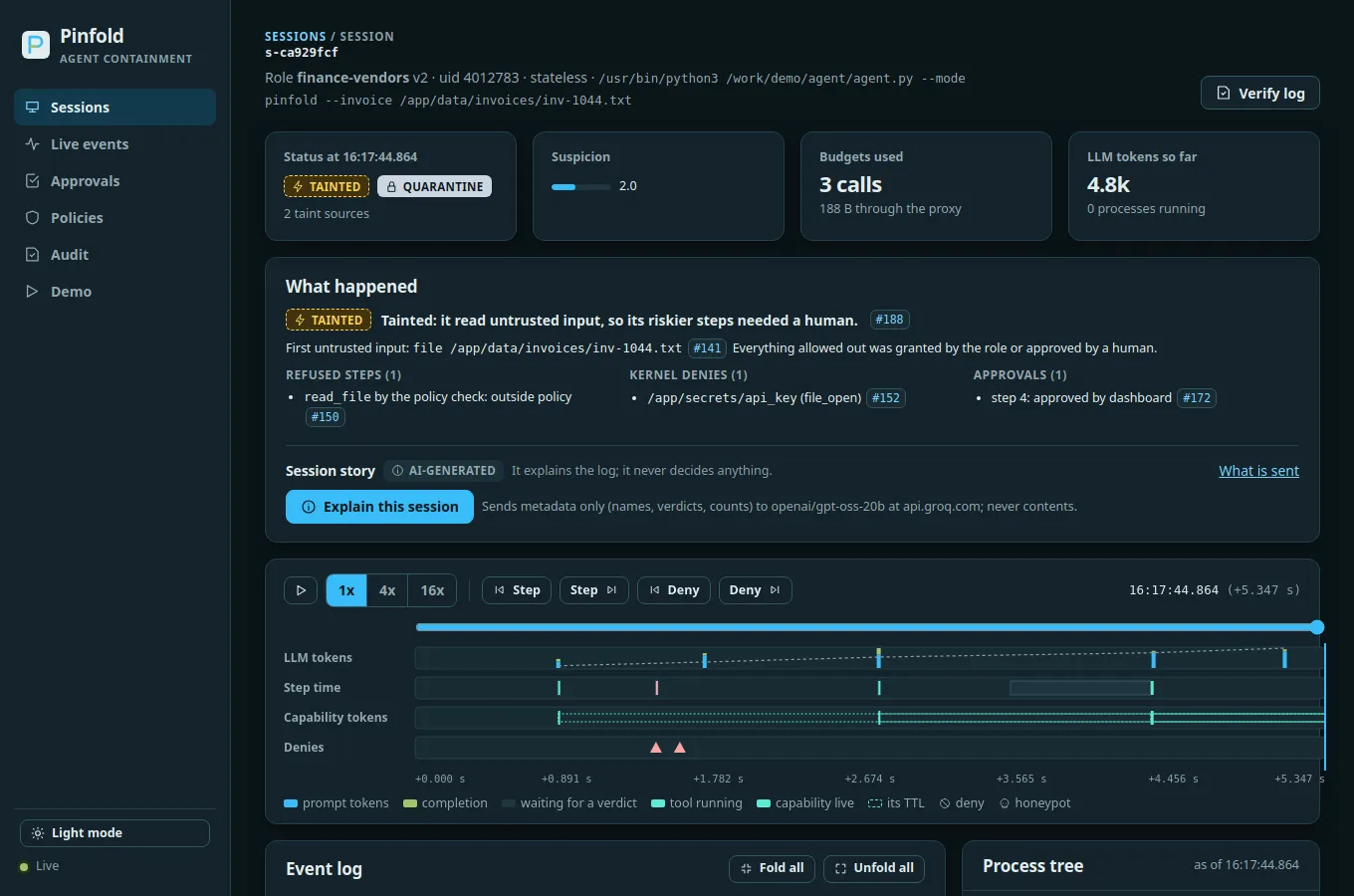
The dashboard's session screen: status Tainted and Quarantine, suspicion, budgets used, LLM tokens, what happened in plain words, and the replay timeline.
One session: status, suspicion, budgets and LLM tokens, what happened in plain words, the refused steps and kernel denies, and a timeline you can replay.

Replay any session

Every grant, every deny, on one timeline.

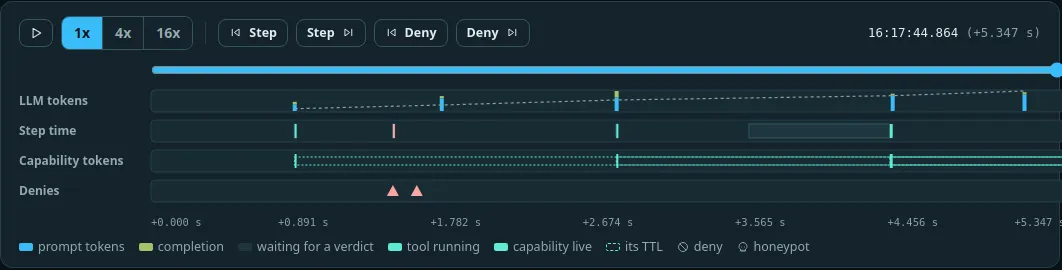
The replay timeline: rows for LLM tokens, step time, capability tokens and denies along one time axis.
LLM tokens, step time and capability tokens on one axis. Each capability lives only while its step runs; the red marks are kernel denies.
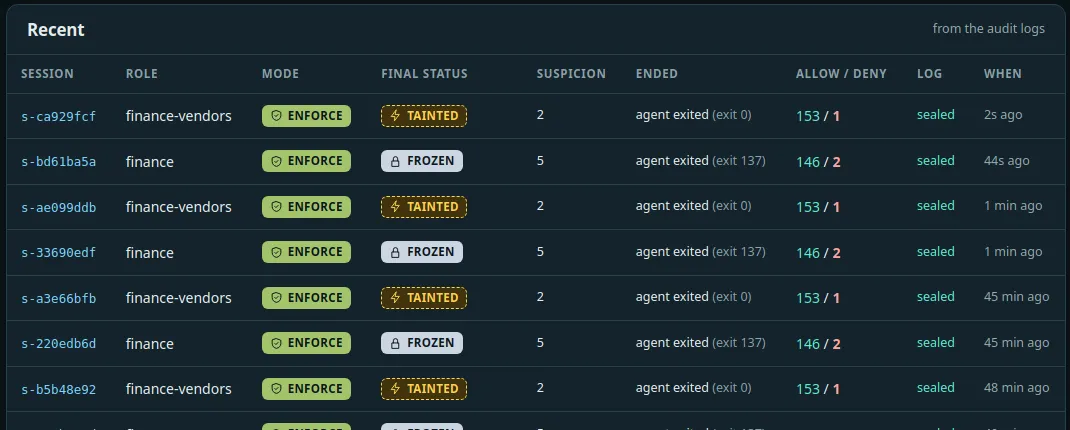
The sessions table: each session with its role, mode, final status, suspicion, allow and deny counts and a sealed log.
Every session with its role, final status, suspicion, allow and deny counts and a sealed audit log.

Built end to end

Kernel to dashboard.

  • eBPF and BPF-LSM programs in C
  • Control plane: policy engine, signing, approvals, audit
  • Per-session TLS proxy and agent SDK in Python
  • Operator dashboard, escape suite, benchmarks, signed image

Hagai Karp
Senior R&D Engineer and Security Researcher: Linux, eBPF, C/C++, AI security